



Most social-science papers are allowed to be a little bit wrong for a while. What I mean by that is the data we deal with are noisy, institutions differ, and human beings do not sit and wait while economists study them. The process often goes like this: a paper finds that some policy raises employment; another later discovers that the estimate depended on a peculiar sample; a third brings better data. The field gradually tightens its understanding of a topic. In many areas, getting the direction approximately right is useful, while getting it a bit wrong for five years or so is not civilizational.
Fertility is different.
Every woman who wants the possibility of carrying a pregnancy has a finite biological window. The timing varies, and medicine can expand some options. But the basic asymmetry remains: the consequences of delaying or forgoing births are often discovered only after the relevant decision can no longer be reversed. At the societal level, the lag is even longer. The macroeconomic consequences of smaller birth cohorts become most visible only when those cohorts reach adulthood—often two or three decades later. By the time economists agree on what happened, the cohort cannot be recreated. And we are still trying to understand what this global decline will mean.
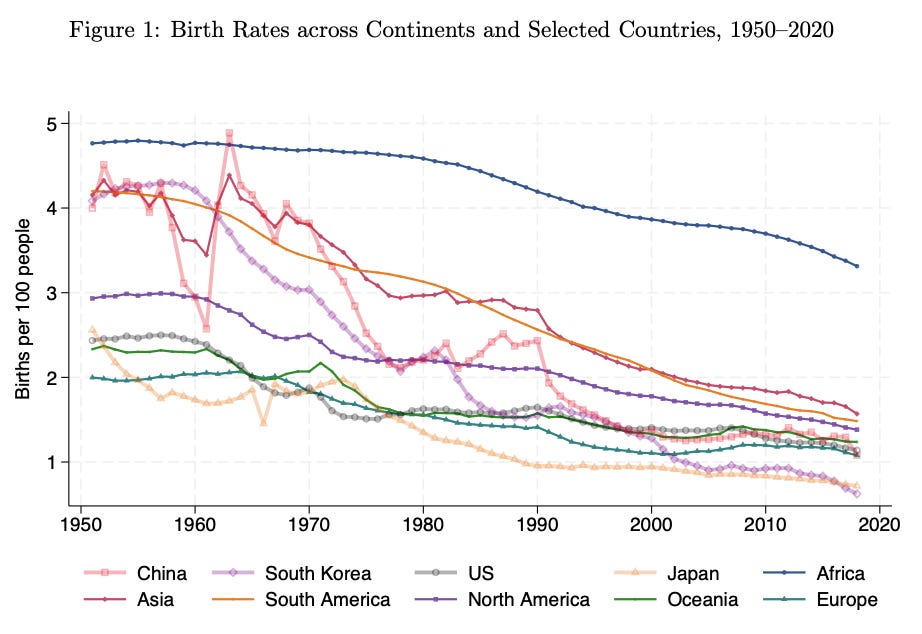
Women who did not grow up in families or social circles where having several children was treated as a central life goal are unlikely to make decisions in their twenties and thirties with replacement-level fertility of roughly 2.1 births per woman in mind.1 Women in advanced parts of the world are living through an extraordinary expansion of autonomy and access to opportunity. That progress should continue. But better information about humanity’s long-run demographic future could still affect how individuals weigh choices in their personal lives.

A recurring social-media trend has women describing themselves as “the first woman in my bloodline to experience …” a telling record of how rapidly women’s lives have expanded. It captures the joy of women finally being able to enjoy all the glory human life can offer: running outdoors safely in clean air, enjoying concerts, beauty and art, and even exploring outer space.
But what if, while enjoying all of this, we do not yet have a clear understanding of how many children we need to sustain this civilizational progress and the human experience we hold so dear? Some women might choose differently if the trade-offs were clearer. A woman might reasonably say, “Traveling through East Asia was enough for now. I can have a couple of children and take the life-changing skydiving trip over the Swiss Alps a few years later.” Human beings are not especially good at evaluating choices when the consequences arrive decades later.
It may not be obvious why having fewer adventures for a period, and returning to them after children are born, could matter for the future creation of the art, music, science, and discovery one cares about. Making a deliberate effort toward having children becomes harder—and present bias more consequential—when the choice women face is effectively between having children now, with a high likelihood of unequal domestic burdens and a career penalty, or taking the trip to Switzerland while the opportunity is immediately available.
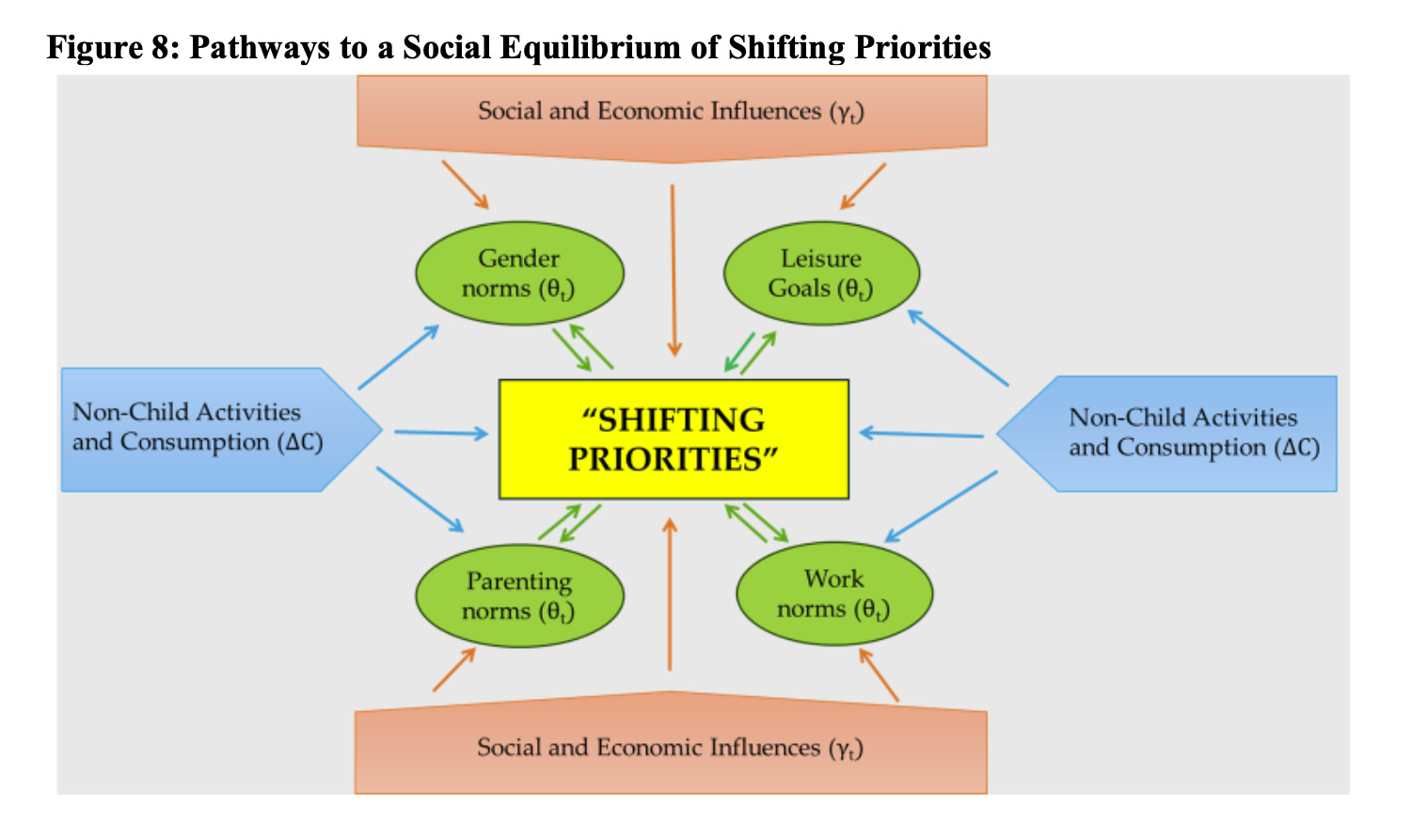
Human beings are not especially good at making choices when the costs are delayed, diffused, and exponential. We are much worse at intuiting how millions of individually reasonable decisions compound across generations.
Consider a simplified example. If the total fertility rate remains at 1.5 births per woman, compared with replacement-level fertility of roughly 2.1, each successive generation would be about2
1.5 / 2.1 ≈ 0.71
Across four generations, the descendant cohort would be roughly:
(1.5 / 2.1)⁴ ≈ 0.26
as large.
At a fertility rate of 1.5, the fourth descendant generation would be only about 26% as large. That is a 74% decline! 74% decline in just four generations! It is simply a demonstration of why exponents are so treacherous. A number that looks modest in one generation can produce a very different civilization a few generations later.
That could mean smaller crowds in the stadiums and concert halls we love, fewer new forms of art and architecture, and fewer breakthroughs in science and space. Many people felt a particular warmth watching a female astronaut travel around the Moon because the moment embodied how far human possibility—especially for women—has expanded. A shrinking talent pool could mean fewer heartfelt moments like that.

Population decline, then, is not merely a concern invoked by traditionalists to pressure women into giving up cerebral and creative aspirations or financial autonomy, sometimes in service of personal or religious preferences. It may also mean less of the beauty, discovery, creativity, and shared achievement that people value most about human civilization.
That is already a difficult argument to communicate to millennials and Gen Z. The consequences are distant, the math is unintuitive, and fertility debates are polluted by ideological actors whose interest ends in “family” without extending the same seriousness to women’s individual liberty, aspirational choices, and lives beyond the home.
That is why a new paper from an all-star cast of economists—Acemoglu, Autor, and their coauthors—arrived with unusual force. These are economists whose work has shaped how many of us understand institutions, labor markets and technology. And the abstract seemed to offer relief: lower birth rates were associated with faster growth in GDP per working-age adult and wages, with “no negative impact” on aggregate GDP or earnings; the authors attributed the result to labor-saving technology and presented evidence from World War II casualties as showing that scarcity of young workers, rather than population decline itself, was the key.
It was tempting to exhale. Perhaps the machines will adjust. Perhaps we are not facing a serious demographic constraint after all. But while the paper contains an important finding, unfortunately it does not establish those bold topline conclusions. Unlike many research questions, fertility is not one where the profession has decades to gradually correct itself. Decisions are made within a narrow window, and a striking claim from scholars of this stature will travel far beyond the seminar room. That makes it especially important to ask whether the evidence can carry the headline.
What the Paper Gets Right
There is a fact here, and it is worth taking seriously. But it is not yet a causal fact. In the baseline cross-country specification, a one-percentage-point lower crude birth rate in 1950—that is, one fewer annual birth per 100 people— is associated with about 23 log points more growth in GDP per working-age adult between 1970 and 2020. Across US commuting zones, the weighted long-difference estimate is roughly 15 log points for composition-adjusted wage growth. The timing fits the proposed story: the relationship emerges mainly after the smaller birth cohort reaches working age.
This is interesting. A forecast that holds productivity fixed and simply subtracts workers will be too pessimistic if economies respond to labor scarcity. Once workers become harder to find, firms have stronger reasons to invest, reorganize production, shift tasks, and adopt technologies that were not profitable when labor was abundant.
Still, the cross-country magnitude is fragile. When education, urbanization, and continental effects are included together, the long-difference coefficient falls from −0.23 to −0.04, with a standard error of 0.12. The US relationship is more stable, but the weighted estimate is three times the unweighted long-difference estimate, meaning much of the headline result comes from larger metropolitan areas—places that also differ in technology, migration, housing costs and long-run agglomeration.
The most defensible conclusion is narrower. Across several specifications, places with lower historical birth rates subsequently experienced faster growth in income per working-age adult or wages, with the relationship strongest in larger US labor markets. This is a valuable result. It is not the same as showing that baby busts cause growth booms.
GDP per working-age adult masks the aging burden
The paper calls its country-level outcome “GDP per worker,” but the denominator is the population aged 20 to 70. It is not the number of employed workers, and it does not account for hours worked.
Let Y denote aggregate GDP and P the working-age population. Then:
Δ log(Y / P) = Δ log Y − Δ log P
If lower fertility reduces P while Y remains stable, GDP per working-age adult must rise. The deeper economic question is not whether the ratio increases. It is why aggregate output does not fall proportionately with the workforce.
Why does this technicality even matter? GDP per working-age adult can rise even while fiscal burdens on working-age people increase, because the denominator leaves out the older population that must also share in the output through taxes and transfers.
How much evidence is there that Y itself is unharmed? Much less. In the main long-difference regression for aggregate GDP, the coefficient is 0.02, with a standard error of 0.14. The corresponding 95 percent confidence interval runs from roughly −0.25 to 0.29. The paper does not detect a decline in aggregate GDP. It also cannot rule out a large one.
Here is the key distinction. The paper’s most precise result concerns Y/P, a ratio whose denominator is itself affected by fertility. The headline conclusion concerns Y, which is estimated far less precisely.
The Causal Leap
The harder step is to move from correlation to causation. The empirical regression is essentially
Δyᵢ,ₜ₊ₕ = α + βbᵢ,ₜ₋₂₀ + γ′Xᵢₜ + εᵢ,ₜ₊ₕ
where b is the earlier birth rate, and X includes initial income and broad population groups. To interpret β causally, the paper needs the lagged birth rate to contain no information about omitted determinants of later growth once X is held fixed. We need something like
E[εᵢ,ₜ₊ₕ | bᵢ,ₜ₋₂₀, Xᵢₜ] = E[εᵢ,ₜ₊ₕ | Xᵢₜ]
This means: Once we condition on the observed controls, places with different birth rates cannot also differ systematically in unobserved factors that shape later growth. If they do, β combines the effect of the birth rate with the effect of those omitted differences.
A simple example is modernization. A country may be undergoing a broader transition that lowers birth rates while also raising future growth -- for instance, by expanding women’s economic opportunities, strengthening institutions, or increasing its capacity to adopt new technologies. Economists call this omitted-variable bias: the regression may end up giving birth rates credit for changes produced by the broader transition. So the authors of the paper then have to make the case that the above equation holds.
This is normally where economists turn to research design, alternative specifications, or some source of plausibly exogenous variation. Here, however, the causal interpretation rests heavily on one sentence near the bottom of page 11: “This observation implies that, conditional on past incomes, past birth rates can be taken as (weakly) exogenous.” The accompanying footnote says the key assumption is that “productivity follows a Markov process and parents use past and current variables to form their expectations—rather than having more information about the future than is available in the data. Specifically, the key assumption is that parents 20 years ago would have no more information about future growth than an econometrician who observes income and population today.” It then equates the expectation of future wages conditional on observed birth rates, wages, and population with the expectation conditional on the entire information set.
“Markov” means that the complete current state contains the information needed to forecast the future. It does not mean that the econometrician’s observed wage and two broad population bins reveal that complete state. A very small counterexample makes the problem visible.
Let qₜ be an unobserved but persistent development state -- perhaps female career opportunities, urbanization, institutional capacity, cultural modernization or anticipated policy. Suppose
qₜ₊₁ = ρqₜ + uₜ₊₁
bₜ = a − λqₜ + vₜ
Δyₜ₊₁ = φqₜ + ηₜ₊₁
Assume λ and φ are positive constants, and uₜ₊₁, vₜ, and ηₜ₊₁ are mutually independent, mean-zero shocks. This economy is Markov. Parents need no private glimpse of future shocks. They simply observe today’s qₜ. A place moving toward high female employment and high productivity may simultaneously have fewer births. Fertility itself can have no causal effect on growth, yet whenever the controls do not fully reveal qₜ:
Cov(bₜ, Δyₜ₊₁ | Xₜ) = −λφ Var(qₜ | Xₜ) ≠ 0
Lower birth rates will predict faster growth for confounded reasons.
To eliminate this example, the authors must assume that observed income and population are sufficient statistics for every persistent state that jointly affects fertility and growth.
The footnote does not establish the condition the regression needs. The regression requires that after conditioning on the controls, the remaining unobserved determinants of future growth must be unrelated to earlier birth rates. If an unmeasured modernization process both lowers births and raises later growth, that condition fails. Additional controls help only if they absorb that process; otherwise β is still a correlation, not a causal effect.
The story fits the facts … up to a point
The theory makes an important point: when firms can choose which technologies to develop and adopt, a smaller workforce can make labor-saving innovation more valuable. In principle, that response can be strong enough to offset the direct loss of workers, so aggregate output need not fall when labor does.
The empirical evidence points in the same direction, but it does not yet trace the mechanism. Places with lower historical birth rates have higher measured total factor productivity, or TFP—the part of output growth not explained by measured increases in labor and capital—along with larger high-tech shares and patent portfolios more concentrated in ICT and, less precisely, automation. Each result has limits. Because TFP is a residual built from the same output, labor, and capital data, when labor falls while output holds up, part of the adjustment will appear as higher TFP. The patent measures are mostly shares, which show a change in the composition of invention rather than an increase in labor-saving innovation itself, and the direct automation estimates are among the least precise. Taken together, these facts are consistent with adaptation. They do not identify a causal chain from lower birth rates to automation to output.
The World War II exercise tries to separate the loss of young workers from the loss of population more generally. Military deaths were concentrated among young men, while civilian deaths were spread more broadly across ages. The problem is that the two forms of mortality differed in much more than age. High civilian deaths often came with bombed cities, destroyed factories and housing, occupation, famine, genocide, and mass displacement; military deaths also produced large imbalances between young men and women. With only 31 countries—and 18 in the age-composition analysis—we cannot tell whether later growth differences came from a shortage of young workers or from these other consequences of the war. The evidence fits the paper’s mechanism, but it does not isolate it.
Finally, much of the paper’s US evidence comes from commuting zones -- local labor markets that can respond to low birth rates by attracting workers, capital, and ideas from elsewhere. Countries can also adopt technologies developed abroad. The world economy has no comparable outside source of young workers or researchers. Evidence that particular places adapt to labor scarcity therefore does not resolve the global question of whether a persistently smaller population would eventually produce fewer discoveries.
The Durable Insight
The paper should give demographic pessimists pause. Its durable insight is that a baby bust does not automatically produce an economic bust. Economies may respond to a smaller workforce through investment, reorganization, and labor-saving technology, making fixed-productivity forecasts too pessimistic. How large that response is—and whether it can persist as population decline becomes widespread—remains an open question.
But the paper does not convincingly establish that lower historical birth rates cause growth booms.
Nor does it establish that aggregate output is unharmed: its long-run estimate is too imprecise to rule out economically meaningful losses, even though the shorter stacked estimates are more favorable. It does not identify the claimed chain from younger-worker scarcity to labor-saving technology to output.
And the historical evidence cannot tell us how that adjustment will work when population decline is larger, persistent, and widespread. To their credit, the authors acknowledge in the conclusion that future demographic changes lie outside the support of their data and that the evidence for the technology response is indirect. Those caveats are much less prominent than the title and abstract.
Women face different constraints—so reasonable they will make different choices. Still, I suspect some men and women might choose differently if the stakes were clearer: this is not only a contest between autonomy and tradition. Social scientists therefore owe the public unusual care when it comes to research on fertility: present findings no more strongly than the evidence allows and bring the scrutiny of the seminar room into public debate before a working paper finding becomes a stylized fact.
It would be comforting if technology gave us an easy way out—if fewer workers simply made economies richer, automation filled the gap, and population declines no longer mattered. But the paper does not get us there. Its strongest result is GDP per working-age adult, not aggregate GDP. And its causal claim rests on assumptions too strong for the conclusion. So unfortunately, there is no easy out.
I thank Vincent Geloso, Liya Palagashvili, Thomas Stratmann, and Alex Tabarrok for their helpful comments and suggestions. All remaining errors are my own.
Replacement-level fertility of roughly 2.1 births per woman in low-mortality populations, absent migration.
I abstract from migration, changing mortality, sex composition, birth timing, and shifts in fertility.
This was really good, thanks
Genuine question as someone who helps and advocates for women obtaining permanent birth control to dispose of unwanted fertility: why should younger cohorts care about population decline when most developed world socioeconomic systems do not care about those in need and providing living wages, affordable housing, affordable healthcare, etc? These systems of extraction want more fuel for their machines and only concern themselves with the structural demographic change rapidly occurring when it means they can’t issue more sovereign debt or extract more profits from workers and consumers. Perhaps the focus should be making a world worth having children into?