



What if building a data center is more like making a movie than running a factory? It sounds like an odd comparison, but consider how a movie gets made. In a 2015 New York Times essay about the future of work, economics journalist Adam Davidson reflected on serving as a technical adviser for The Big Short. What struck him was not the celebrities but the way the work was organized.
A movie assembles hundreds of specialized workers—electricians, carpenters, set designers, makeup artists, and camera operators—for a limited-time filming project. When this project ends, the team disperses, but the workers carry their skills, credits, relationships, and reputations to the next production. We wouldn’t evaluate Hollywood’s labor market by asking how many workers remain employed by a single production after the set comes down.
“This approach to business is sometimes called the ‘Hollywood model.’ A project is identified; a team is assembled; it works together for precisely as long as is needed to complete the task; then the team disbands.” -Adam Davidson
The Hollywood model is quite different from both traditional employment and much of the gig economy. The traditional factory model centers on long-term attachment to one facility, while task-based gig work often consists of individual transactions, with little shared infrastructure connecting one job to the next. Hollywood’s project model can include W-2 employees, freelancers and contractors, unions, occupational ladders, recognized credits, and recurring professional networks. When one filming job ends, the career trajectory can continue across projects.
Data-center construction may deserve the same lens. A data center’s most labor intensive phase is the time-bound construction stage. Once it is built, a smaller, ongoing operations workforce oversees maintenance and operations. The relevant question is not how many permanent jobs remain after the servers switch on, but what workers and local firms can carry forward once the project is complete. Workers may gain training, skills, credentials, and experience that help them find their next job. Local construction firms may build the capabilities, track record, and relationships needed to take on the next complex project.
From 1,500 to 50
The standard data-center jobs story focuses on the sharp difference between peak construction employment and the much smaller operations workforce. Virginia’s Joint Legislative Audit and Review Commission reports that a typical 250,000-square-foot facility can have about 1,500 workers on site at its peak during as much as a year and a half long construction period. Once that facility is operational, however, it may only have roughly 50 full-time workers on staff, about half of them in contract positions and some of them remote from the company’s head office.
Critics will look at those figures and treat the decrease as 1,450 jobs disappearing. Industry advocates, on the other hand, point to the 1,500-person construction site and talk about a jobs boom. Both descriptions use real numbers, but neither tells the complete story about what actually happens to the workers themselves. Peak headcount and job-year ratios aside, what we really need to know is whether workers gained portable skills, if local firms became better positioned to win future projects, and whether other durable local opportunities were created.
One NBER working paper finds positive effects on county employment, construction activity, establishments, payroll, and wages. Its longer-horizon results show persistent gains in employment and establishments, while, predictably, construction effects are strongest at shorter horizons. A Brookings analysis updated in August 2026 finds more modest gains of about 100 to 200 jobs in a typical county and no measurable wage increase.
Both studies measure county-level outcomes rather than individual workers’ career paths. They can show whether employment and economic activity rose in a county, but not whether the workers who built a facility gained portable skills, moved into better-paid work, or found another job after construction ended.
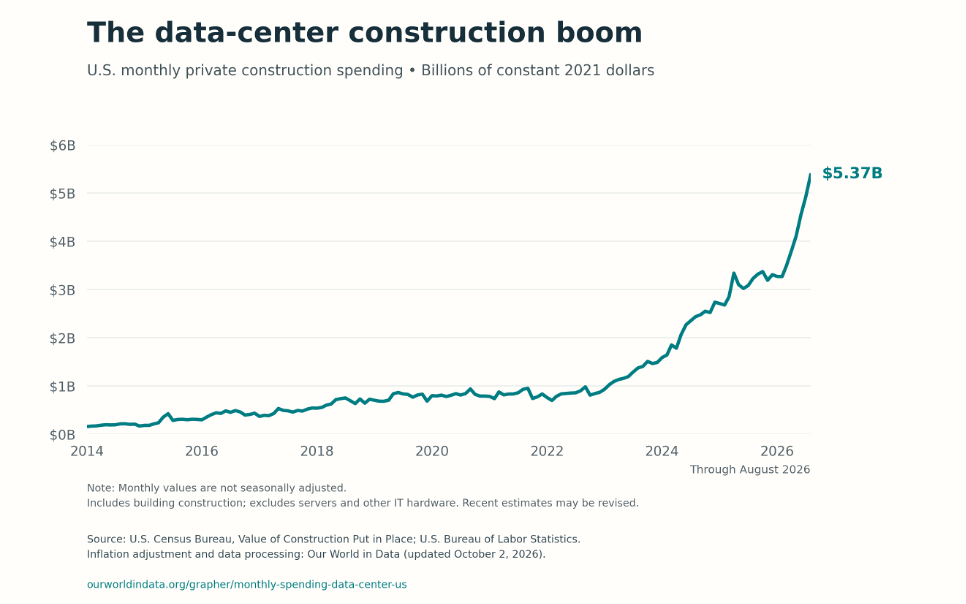
The scale of the construction boom is also clear in the chart above. The data indicate that monthly U.S. data-center construction spending rose significantly in recent years. But high volume spending and a large number of workers on a temporary, busy site is only part of the story. The missing part is the worker-level story and it is where the Hollywood analogy becomes useful.
Construction Is Already Project-Based
Unlike a factory, which can produce the same product continuously in one place, construction is organized around specified projects with a clear beginning and an end. A data center, a hospital, or a bridge is built by a construction crew, and then handed over for designated use. Once a project is complete, the engineers, electricians, HVAC technicians, and other workers move to another construction site. Given that demand for specialized trades is substantial but intermittent, each project brings together internal crews, subcontractors, and other specialized teams for a limited period of time.


Hollywood has developed its own infrastructure for temporary work: specialized roles, professional networks, repeat collaborators, and credits that signal what workers have done before. Together, these networks help production teams identify who can do which part and whom they can trust to do it well, so each production does not begin from zero. Research on film-industry careers and coordination within temporary film crews shows how workers can build careers across different employers and productions, preserving continuity even when individual projects are designed to dissolve.
The relevant distinction here is not between employees and independent contractors, but between permanent attachment to one facility and a career built across a sequence of individual projects.
That distinction matters for data centers because construction is their most labor-intensive phase. Electricians, HVAC technicians, welders, equipment operators, fiber specialists carry valuable skills from one project to the next. They can go from building a data center to working on semiconductor plants, hospitals, manufacturing facilities, or another data-center build. Not every site-specific skill or credential will transfer to another project automatically. And, most certainly, a completed facility cannot keep its peak construction workforce forever.
Thus, a datacenter build should not be judged only by the jobs it creates while the cranes are up, but by whether it creates a bridge to future work. Do workers leave the project with portable skills, experience, and credentials? Are local construction firms better positioned to participate in future complex projects? Does the project leave behind a stronger local labor-market ecosystem?
When Temporary Work Builds a Lasting Career
For a data-center construction workforce, a lasting career does not require staying at one facility or with one employer. It can be built across projects through paid apprenticeship hours, portable credentials, transferable skills and experience with critical systems, subsequent wage growth, and access to an ecosystem of employers, construction firms, training programs, and professional networks that connect workers to continued opportunities.
In other words, the ecosystem is what turns a series of temporary jobs into a career.
That ecosystem operates at several levels. For workers, it can provide training, credentials, professional relationships, and connections to the next project. For construction firms, it can produce teams with experience delivering high-quality work on schedule, along with the reputations and relationships needed to take on future projects. For a region, it can create a deeper pool of specialized firms and workers that makes the next infrastructure project easier to staff. Skills and credible information about who can do the work reduce the cost of assembling the next team.
The career-building potential of project-based work is strongest when skills easily transfer, credentials are recognized, and workers can access another project or related job when the first one ends. That opportunity may be nearby or in another state. What matters is whether the project adds to a continuing career rather than ending with the build. For the host county, however, local benefits are more likely when local workers and firms are connected to the project and to the work that follows.
Loudoun County offers a suggestive, though incomplete, example. Employment at electrical and plumbing/HVAC contractors has grown faster than Virginia’s statewide benchmark. The chart below shows expansion in local contractor employment. Even though Loudoun County is colloquially known as the data center capital of the world, we cannot definitively state data centers caused observed growth nor that the same workers moved successfully from one project to the next. These industries serve many types of projects, so the comparison cannot isolate the contribution of data centers. But it points toward a broader question of this essay: what happens to the local workforce and contractor base across successive projects?
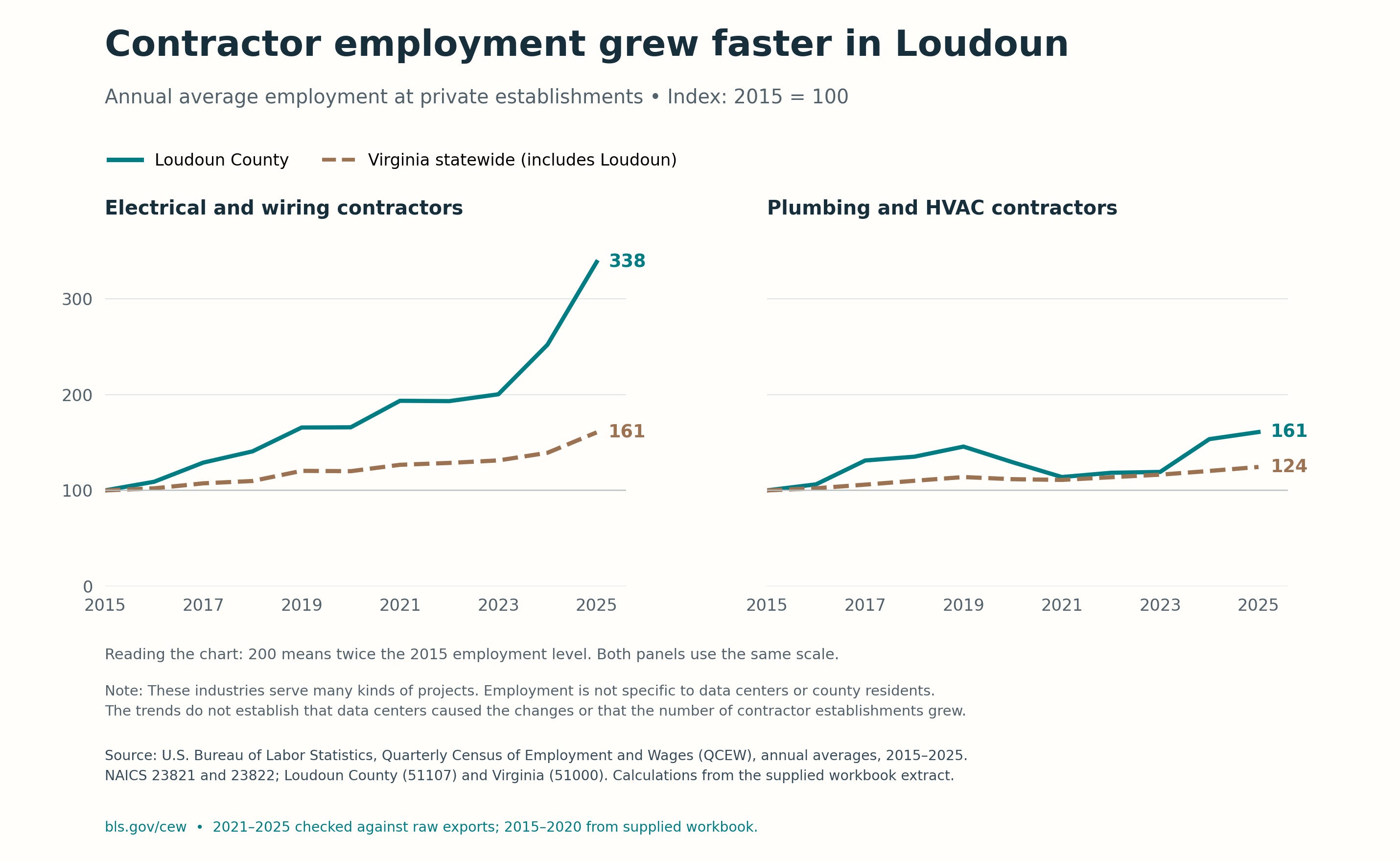
Employment growth is, therefore, a useful signal of a growing local market. For the evidence that workers have built lasting careers we would need to turn to other forms of research such as surveys, interviews, and personal stories.
Recent corporate training announcements suggest that firms are eager investors in this ecosystem. Amazon’s Built Together program supports community college training in fields such as electrical work, HVAC, fiber, and heavy equipment. Meta’s $115 million America’s Workforce Academy offers paid training, industry-recognized credentials, and connections to partner construction sites. Microsoft’s Datacenter Academy focuses more on preparing people for ongoing data-center operations roles. Other firms, including Google, QTS, and BlackRock, have announced related investments in skilled-trades training and apprenticeship capacity.
These announcements are important inputs. The meaningful outcomes would include how many workers complete the pathway, earn credentials, remain in the trade, find subsequent work, earn higher wages, and whether local firms gain the capacity to participate in future projects. A credential and a solid reputation may travel with a worker even when the license required to perform particular work does not.
What Does a Data Center Leave Behind?
Hollywood is not a labor-market utopia, certainly not for everyone. Its project-based model can support a lasting and fulfilling career for some workers. For others, it can mean gaps between projects, unpredictable schedules and income, and uncertainty about what comes next.
Nor is permanent headcount at a finished facility a complete measure of labor market value. A data center does not need to employ 1,500 people forever to shape workers’ future opportunities and careers.
Once the data-center build is wrapped up, where did the workers go next? Did they carry their skills into new jobs, earn higher wages, or help build the next project? Did the project strengthen the local labor-market ecosystem? Those questions tell us far more than simply asking how many people remain inside after the cranes leave.
Hollywood is also one of the more heavily unionized industries and one of the only industries with widespread sectoral bargaining. This seems to be a huge factor that makes the portable contract-based system of employment work in Hollywood. I'm surprised this wasn't mentioned.