



This piece is a guest contribution from Yuliya Yatsyshina, Program Manager of the Labor and Fiscal Policy Projects at the Mercatus Center. This spring, Labor Market Matters is kicking off a series exploring the intersection of H-1B visas and the broader labor market. Over the coming months, we’ll be sharing a few pieces examining how high-skilled immigration policy shapes wages, hiring, and economic opportunity.
This month marks the first round of the H-1B lottery conducted under a new rule requiring U.S. employers hiring specialty occupation workers from abroad to pay fees of up to $100,000 per application. These unexpectedly high costs reportedly caught many H-1B employers off guard. Combined with a shift toward prioritizing higher-paid, “merit-based” positions, the policy was introduced by the Trump administration to curb alleged fraud and abuse in the temporary visa system.
In practice, however, the measure functions as a tax on foreign labor which risks generating long-lasting and unintended consequences for U.S. labor markets and the broader economy.
The stated policy objective
One of the administration’s main objectives with this policy is to protect American workers by discouraging reliance on lower-cost foreign labor while prioritizing the admission of exceptionally high-skilled workers.
But will such a drastic policy shift actually deliver a net benefit to the United States or to American workers in particular? Will it meaningfully reduce the alleged fraud it targets? And what broader economic consequences can we expect from raising new barriers to legal immigration?
Economic realities
The full effects of any policy change are difficult to predict. However, a fee of this scale, which is effectively a tariff on foreign labor, will likely cause firms to adjust their talent sourcing, leading to disproportionate effects across businesses and industries. While large firms may be able to absorb the added costs, small and mid-sized companies are more likely to face heightened barriers when competing for international workers.
At the same time, recent simulation evidence suggests the fee may have only a limited impact on employer demand in some cases. On average, H-1B workers earn about 15 percent less than comparable native workers, implying that firms may still be willing to pay a one-time fee to secure these hires. In practice, this means some employers could offset the added cost by adjusting compensation either for foreign hires or for domestic workers.
In the cases where wage gaps are already narrow, particularly in large tech firms such as Amazon, Google, and Microsoft, these adjustments are more likely to come at the expense of new hires regardless of origin, as firms rebalance overall labor costs. As Nvidia CEO Jensen Huang has noted, while a $100,000 visa fee could pose a meaningful barrier to opportunity, firms may still choose to pay it when the expected returns justify the cost.
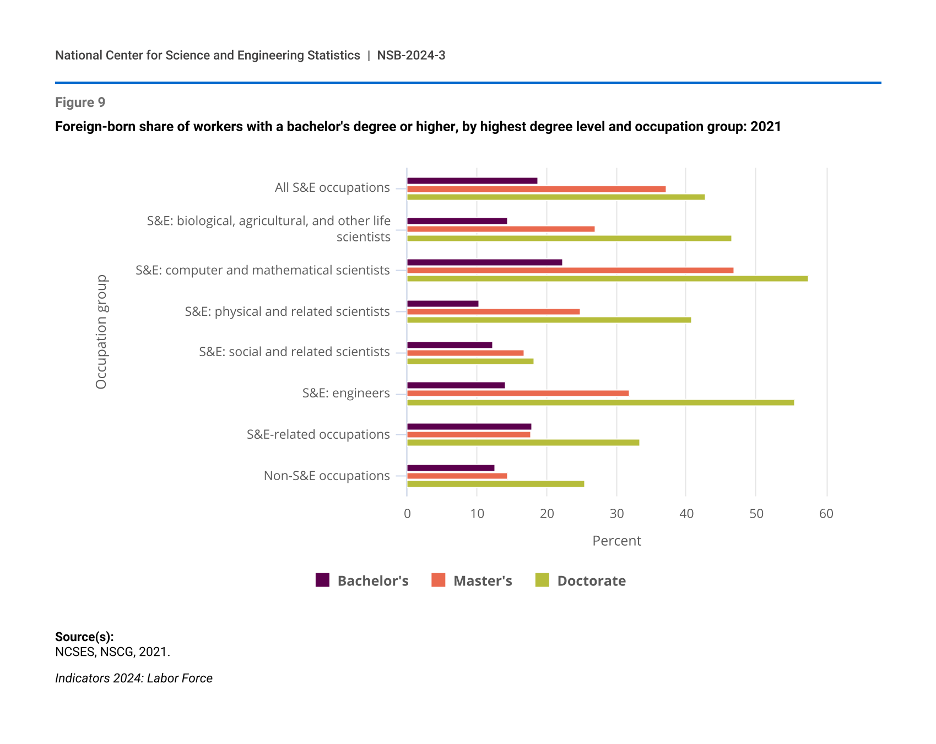
Additionally, the United States does not produce enough STEM graduates domestically, creating a structural reliance within the tech sector on foreign-born talent, as reflected in National Center for Science and Engineering Statistics data (see figure below). So far, India remains a leading producer of high-quality technical graduates, while China continues to significantly outpace the United States in the production of STEM PhDs.
Given the relative scarcity of STEM talent, strong U.S. productive capacity, and intensifying competition from AI, demand for foreign-trained labor is unlikely to decline. When the cost of key inputs rises, firms adjust toward cheaper or more accessible alternatives.
A $100,000 H-1B fee raises the marginal cost of hiring foreign specialty workers, incentivizing substitution across several margins including increased offshoring to foreign affiliates, greater reliance on remote contractors, automation, or shifting operations to jurisdictions with more predictable immigration regimes. However, when considering offshoring, smaller firms cannot use that as easily as a Google or Amazon, so some may lose access to talent entirely.
Highly skilled workers remain a scarce and essential resource, and no technological shortcut, including AI, is likely to change that in the near to medium term.
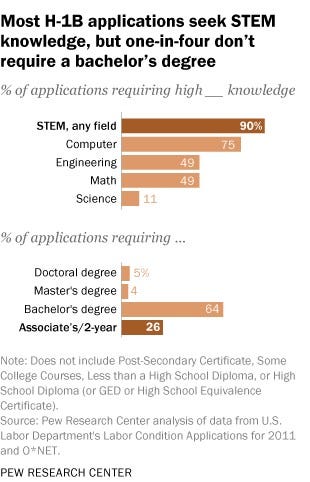
While some argue that AI could offset domestic talent shortages, this view overlooks how technological change reshapes, rather than eliminates, labor demand. As AI advances, it generates new roles and shifts skill requirements, increasing the need for specialized expertise. According to Pew Research, nine in ten H-1B requests are for jobs requiring some high-level STEM knowledge, which suggests that employers are not exploiting the system but simply solving the economic problem of persistent shortages of skilled labor.
Ample research confirms that work visa restrictions generate many unintended consequences. In an earlier policy brief, Liya Palagashvili explains that limiting H-1B visas does not reliably achieve the stated goal of protecting American workers.
For example, using H-1B visa microdata and Bureau of Economic Analysis data on U.S. multinational firms, Britta Glennon (2020) shows that restrictions on high-skilled immigration lead multinational firms to expand foreign affiliate employment abroad such as in Canada, India, and China. She finds that for every visa rejection, the average firm hires approximately 0.42 employees overseas, rising to 0.93 for the most globally integrated firms. In other words, the firms are likely to add approximately two to three overseas employees for every visa rejection.
Evidence on domestic labor markets points in a similar direction. Palagashvili’s review of the literature finds that H-1B workers do not reduce aggregate employment or wages for American workers. While there may be localized or occupational shifts, such as within computer science fields, there is no evidence of overall job loss attributable to the H-1B program. Indeed, the preponderance of evidence indicates that restricting H-1B visas may undermine, rather than advance, the goal of strengthening outcomes for American workers.
Firms also adjust through regulatory arbitrage. Employers adapt by navigating around immigration restrictions through alternative channels to bring in foreign talent. When compliance costs increase sharply, firms have incentives to search for alternative legal visa categories that allow them to avoid the fee. In practice, this may mean restructuring job classifications, shifting workers to other nonimmigrant visa categories, partnering with third-party staffing firms that are able to bring talent exploring alternative visa systems, such as from OPT (F-1) to H-1B.
All of these adjustments require time and resources, meaning the policy’s ultimate impact will depend less on its intended deterrent effect and more on how firms substitute across these margins. The upcoming FY2027 registration data will provide early evidence on whether the reform meaningfully reshapes high-skill labor markets or primarily induces offshoring and reallocation.
Notably, the policy is expected to generate between $10 and $20 billion in annual revenue. This is a transfer from employers to the federal government. Basic economic theory predicts that such a tax will create deadweight losses by preventing mutually beneficial exchanges. These losses may take the form of fewer hires, reduced innovation, and diminished consumer benefits. While federal revenues may rise, the burden is to fall on firms, workers, and consumers.
On the issue of fraud
Visa fraud is a complex issue, and in the H-1B context, it is essential to distinguish between different types of violations and their prevalence. Unfortunately, little recent peer-reviewed research exists. The most frequently cited evidence remains a 2008 USCIS study, which identified problems in roughly 20 percent of applications which lumped together both outright fraud and minor technical violations.
Only 85,000 H-1B visas are issued annually, compared to more than 400,000 F-1 student visas and nearly 6 million B1/B2 tourist visas. Incidents of fraud and noncompliance issues are far more likely with these visa categories. Focusing enforcement on H-1B alone therefore targets a relatively small share of overall visa activity.
Moreover, the new fee is unlikely to meaningfully reduce fraud given the availability of alternative pathways for high-skilled workers. In addition to OPT (F-1) opportunities, employers can turn to other visa categories such as O-1, EB-1, EB-2, and EB-3. As a result, raising the cost of H-1B applications may shift behavior across programs rather than address underlying compliance issues.
More problematic is the lack of sufficient resources and incentives for USCIS and Consular services to identify, investigate, and reduce fraud before an application is approved. For these reasons, a fee-based deterrent is a poor fit for the problem of fraud since it takes numerous forms such as misclassified job roles, speculative filings by staffing intermediaries, and wage manipulation, none of which are meaningfully discouraged by raising the entry price.
A more effective approach would emphasize targeted enforcement such as enhanced auditing, stronger penalties for bad actors, and more robust site visit requirements. These measures would better address abuse and avoid placing unnecessary burdens on the many employers and workers who participate in the program in good faith.
Furthermore, recent research by Adam Ozimek and Sarah Eckhardt finds that H-1B holder who do apply in good faith generate substantial positive balances: “the average H-1B household contributes $30,050 net annually — 2.6 times the $11,530 contribution of a typical U.S. household.”
What’s actually at stake
A substantial body of evidence shows that high-skilled immigration strengthens the resilience of the U.S. economy, supports labor market dynamism, fuels innovation in strategic industries, and contributes positively to the nation’s fiscal health. In short, the benefits far outweigh the risks.
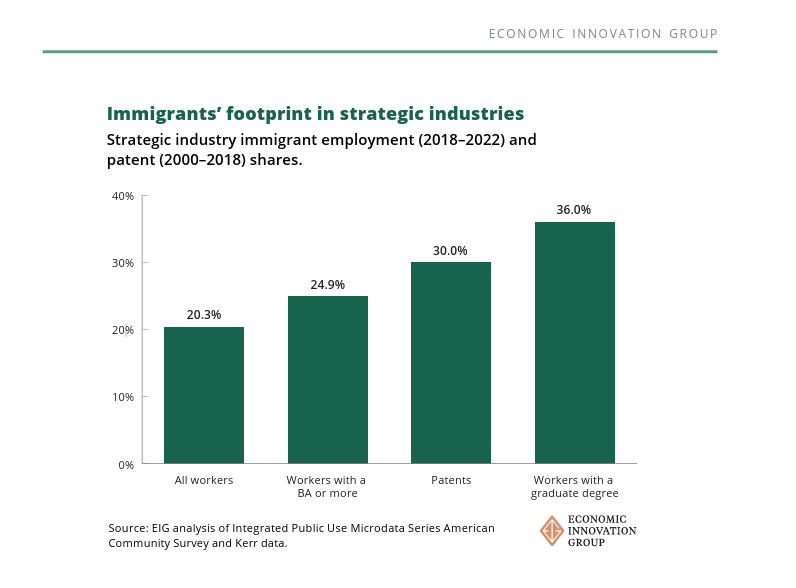
However, an increasingly outdated immigration system with rising fees and increasing barriers to high-skilled immigration creates a significant policy trade-off. The U.S. government may stand to gain billions in additional revenue, but the costs to productivity, innovation, and competitiveness may far outweigh that hoped-for windfall. Congress has already introduced a bill for fee waivers for H-1B healthcare workers in recognition of the policy’s initial negative consequences.
Rather than continuing to patch a system that distorts incentives and constrains growth, policymakers should reconsider the broader framework. At stake is not just access to talent, but America's position as a global leader in technology, a standing that is tested continuously given intensely competitive global landscape.
Ultimately, high-skilled immigration policy is not merely a domestic labor question, it is a strategic lever with consequences that extend well beyond U.S. borders. When talent can move more freely across borders, the American and global economies prosper.