


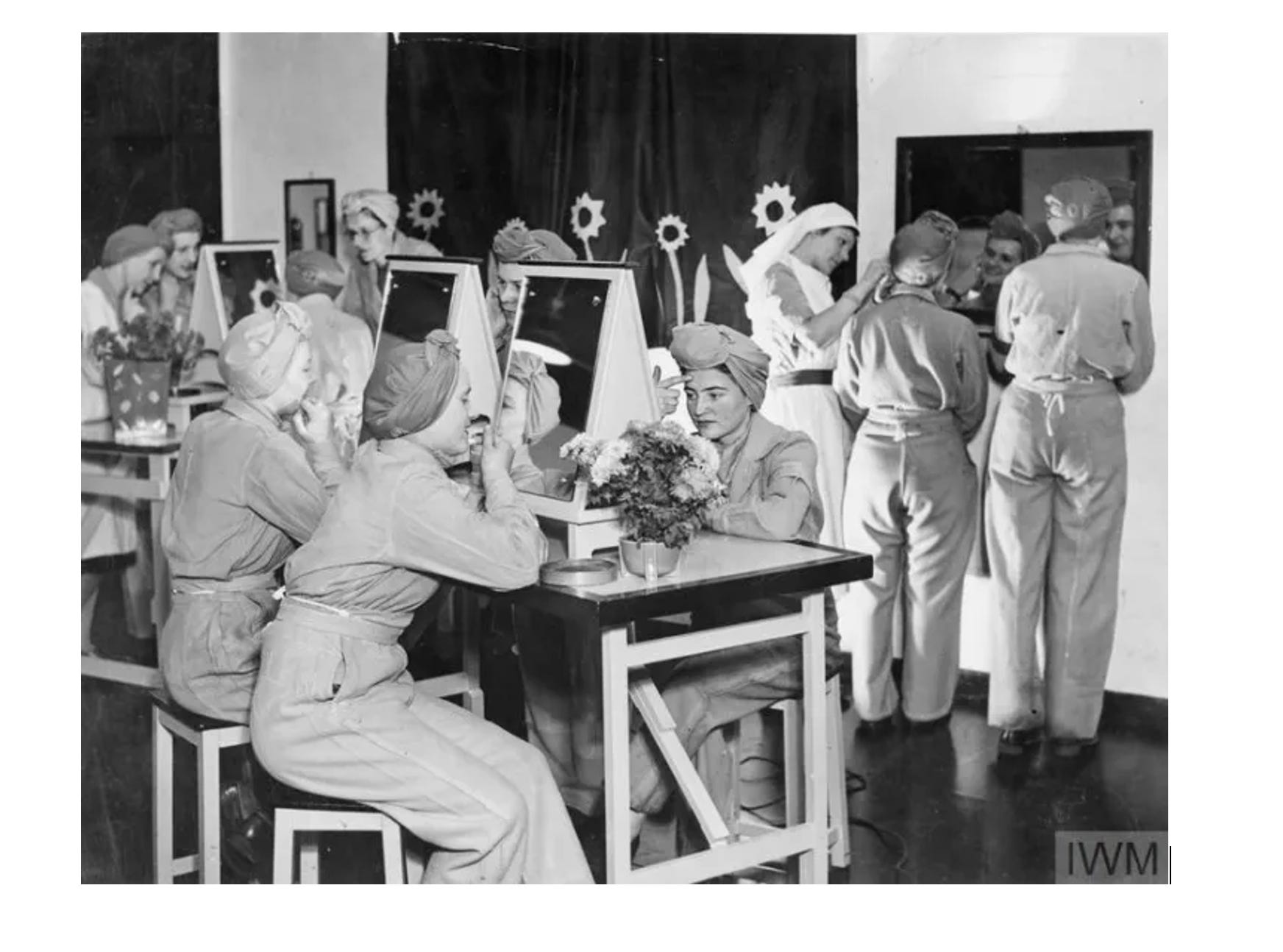
Helen Andrews, a conservative commentator and author, argues that rising female participation is reshaping how institutions function. The mechanism, in her account, runs through norms. As gender composition shifts, so do the informal rules governing conflict, debate, and internal competition.
Institutions become more conflict-averse, more focused on consensus, less tolerant of the kind of blunt internal contestation that she associates with high performance. Over time, she argues, this gradually degrades how institutions execute their core functions. That is a causal claim, and it has observable implications.
Two empirical tests of that claim happen to be available. The first looks at moments when female participation shifts rapidly and institutional performance is easy to observe. A war economy – where objectives are explicit, output is measurable, and failure is catastrophic – provides the sharpest possible version of that test.
The second looks at the long run. If feminization erodes institutional effectiveness, the decades-long movement of women into high-skill professions should leave a productivity footprint: the institutions Andrews worries about most should show signs of declining output as female share rose. We have evidence on both.
Neither test was designed to answer Andrews’ question. But both speak to it. And the results are not what her framework predicts.
A war economy is an allocation problem
A modern industrial war is the most unforgiving kind of macroeconomics. Countries must convert finance into output while operating under tight constraints: steel, shipping, skilled labor, factory capacity, logistics. Strategy matters, but much of wartime success comes down to something simpler. Institutions have to allocate resources toward the sectors that produce war materiel.
A neat paraphrase of that logic: money wins wars; wars redistribute talent; talent makes money.
That’s a useful frame for what follows. When Andrews argues that feminization changes how institutions behave, she is implicitly telling us which variable she thinks belongs on the right-hand side of the institutional performance equation¹ – that is, which factor she believes is driving institutional outcomes. A war economy is where that claim meets its hardest test.
What Andrews is claiming
Andrews begins from an observation that is hard to deny: women now occupy far more of the professional and institutional terrain than in the past, and she asks why we assume institutions will function under these “novel circumstances.”
She is careful, in one important way. She does not rest her argument on women being less talented. She argues instead that “female modes of interaction” are not well suited to the goals of many major institutions – academia, corporate life, politics – where she associates institutional success with open debate, competitive striving, and truth-seeking.
Set aside whether those are the only goals of these institutions. The analytic move is that she treats gender composition – or what she thinks gender composition does to norms – as a structural determinant of performance.
You might think this is a semantic point. It isn’t. It changes what evidence we should care about.
If composition is the primitive, then rising female share should predict institutional degradation in settings where performance is observable and stakes are high. WWII is exactly such a setting.
The numbers that moved
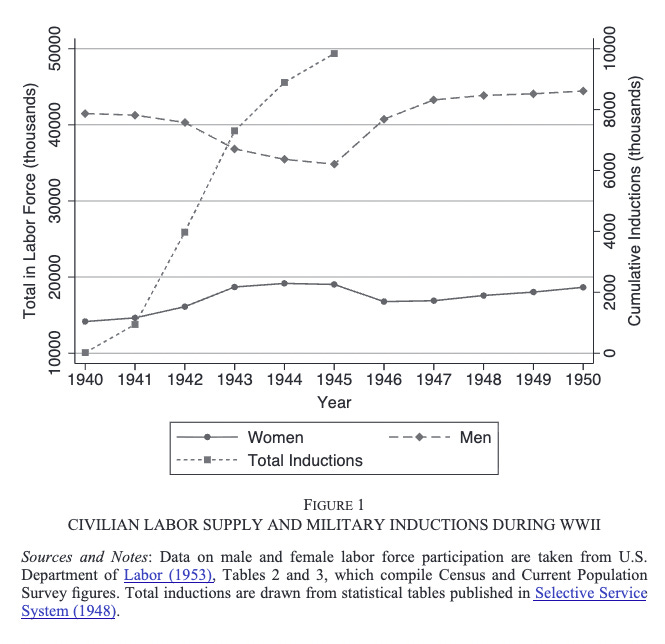
In 1940, the U.S. civilian labor force included about 13 million women, roughly a quarter of all workers. By July 1944, that number had risen by more than 6 million – nearly half the 1940 level – with over nine-tenths of the new entrants in non-agricultural work. By July 1945, women were 35% of civilian workers. Those are not marginal adjustments. They are the kind of labor supply shock that normally only appears in textbooks in hypothetical settings – except here it happened in a handful of years, driven by mobilization.
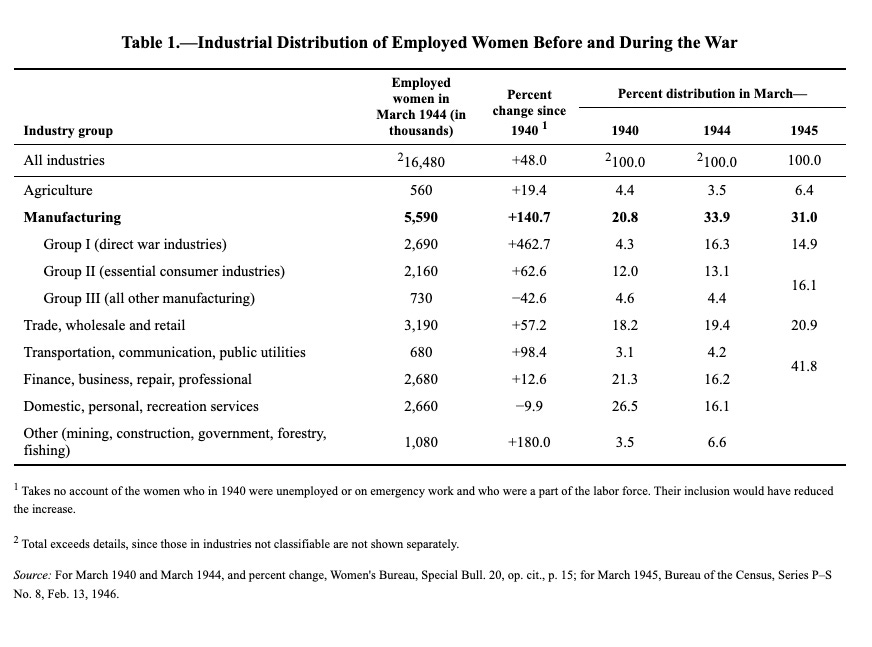
Manufacturing is where the constraint was tightest, so it is the most relevant sector to examine. Between 1940 and March 1944, women’s employment in U.S. manufacturing rose by more than three million, and women’s share of total female employment in manufacturing climbed from 21% to 34%. This was not clerical work or supporting roles at the edges of production. It was entry into the sectors producing war materiel – the sectors where the output function was most clearly defined.
Britain faced tighter constraints. By 1944, over seven million women were engaged in war work. The Essential Work Order of March 1941 tied workers to essential jobs and restricted dismissals without Ministry of Labour approval. By early 1941, women aged 18 to 60 were required to register for war work; conscription followed.
Economists Acemoglu, Autor, and Lyle show that this was not coincidence. Exploiting variation in WWII mobilization rates across U.S. states, they find that higher mobilization rates were associated with larger increases in women’s labor supply – consistent with a supply response to male labor withdrawal rather than slow-moving cultural change.
At this stage, a sympathetic reader might say: of course, women worked. Wars force everyone to work. The question is whether institutions stayed good at what they were supposed to do. That is the right question – and it forces us to be precise about the mechanism.
What the causal model should look like
Andrews’ thesis puts gender mix in the driver’s seat: change the composition of the workforce, and the norms change with it. But WWII inverts that story. Institutions first changed their objectives and restructured incentives around binding constraints. Women entered because the demand for their labor shifted -- not because norms did. Composition was the outcome, not the input.
In Britain, the Essential Work Order exists precisely because turnover, misallocation, and poaching are performance problems in wartime. In the U.S., the wartime expansion of women into manufacturing and war industries is not explained by a sudden national embrace of feminist workplace norms; it is explained by a binding scarcity of labor in the sectors that produced war materiel.
You might think: perhaps wartime institutions performed despite feminization, not because of it. But that concedes the key analytic point. If “female modes of interaction” are structurally incompatible with institutional goals like output maximization, open contestation, and high-tempo execution, the setting in which those incompatibilities should bite hardest is a war economy – when “safetyism” is a luxury. Yet the institutional response was to widen women’s participation, not restrict it.
That doesn’t prove institutions are always gender-neutral machines. It does tell us that gender composition is rarely the primitive variable. Incentives and constraints are.
The part we should not overstate
This is not an argument that wartime feminization produced permanent transformation, or that WWII proved gender to be irrelevant to all institutional dynamics.
The postwar reversion was real and swift. From July 1945 to January 1946, the Women’s Bureau recorded a drop of nearly four million women from the labor force. Economist and Nobel Laureate Claudia Goldin’s retrospective work finds that almost half of wartime female entrants had exited by 1950, and concludes that WWII’s direct influence on women’s long-run employment was “considerably more modest” than popular narratives suggest. Economist Evan Rose’s work confirms limited lasting effects on female participation by 1950 in the most mobilization-exposed areas.
Andrews might read this as confirming her view: the wartime feminization was temporary because it was externally imposed, and when the coercion lifted, equilibrium re-sorted back toward the “natural” gender distribution.
But this reads the evidence backwards. The reversion is explained by the same causal model we have been using: when the constraint relaxed and the objective function changed – when the government stopped prioritizing war production and started prioritizing veteran reabsorption – the labor market equilibrium shifted. Women’s participation moved with those incentive changes, not against them. That is not evidence of an underlying female preference for domestic life reasserting itself over institutional resistance. It is evidence that labor supply responds to incentive structures, which is the whole point.
The war test asks a narrower question than the postwar numbers do: under maximal stakes and tight constraints, could institutions still function with rapidly rising female participation? The answer is yes, unambiguously. They did not collapse into conflict-avoidance.
But that wartime result should be read carefully. It does not tell us that institutional norms are irrelevant, or that long-run cultural change never matters. It tells us something narrower and more useful: gender composition alone was not enough to prevent institutions from meeting demanding, measurable objectives. Under wartime pressure, performance turned on incentives, constraints, and efficient allocation of labor.
A study that helps clarify the mechanism
The wartime evidence tells us what happened under pressure. A 2019 study by economists Hsieh, Hurst, Jones, and Klenow tells us why the expansion of women into high-skill work continued afterward and what drove that long-run shift.
1. Falling barriers, not changing norms, did most of the work.
HHJK explicitly decompose occupational convergence into two potential drivers: declining frictions, such as labor market discrimination and barriers to human capital, and changing preferences. Their finding (Table V, column 2 vs. column 1): changing occupational preferences “explain little of U.S. growth during this time period.” The discrimination and barriers to human capital alone explain 41.5% of market GDP per person growth; add preferences in and you get 40.8% – preferences contribute essentially nothing and may slightly reduce growth.
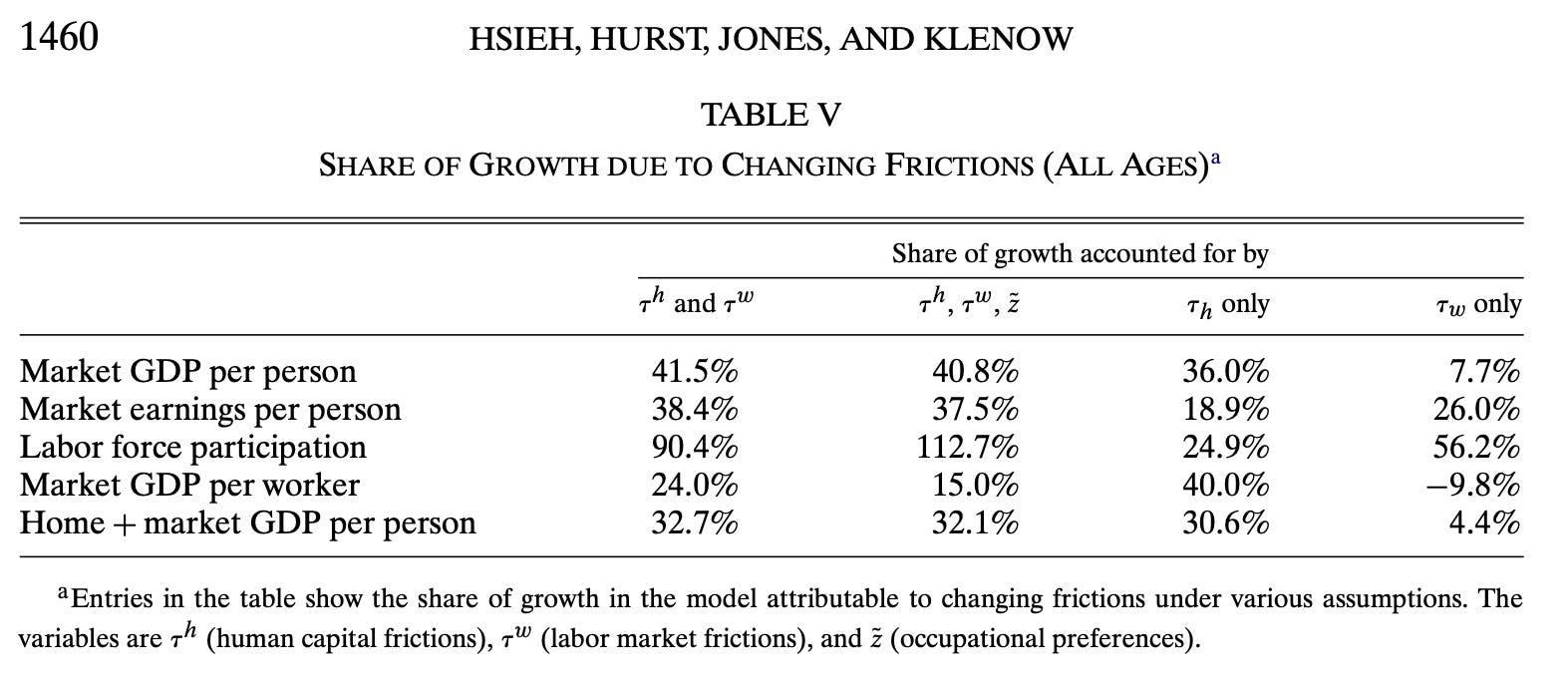
Andrews’ explanation is fundamentally about norms. HHJK point to a different mechanism. Much of the occupational convergence she reads as feminization looks, in their framework, like the removal of barriers to comparative-advantage allocation. In the baseline decomposition, preferences contribute little to growth, while falling frictions do most of the work. That does not rule out every role for norms. But it does suggest that the large movement of women into elite occupations is better understood, in economic terms, as a correction of misallocation.
2. The highest barriers were in exactly the institutions Andrews worries about.
Figure 4 in HHJK is one of the strongest exhibits. The vertical axis shows the size of the barrier women faced when entering each occupation. Higher values mean larger barriers. In 1960, the barriers were very large in professions like law and medicine. Over the following decades, they fell sharply. Construction remained high over time, which the authors note could reflect comparative disadvantage in physical-strength tasks.
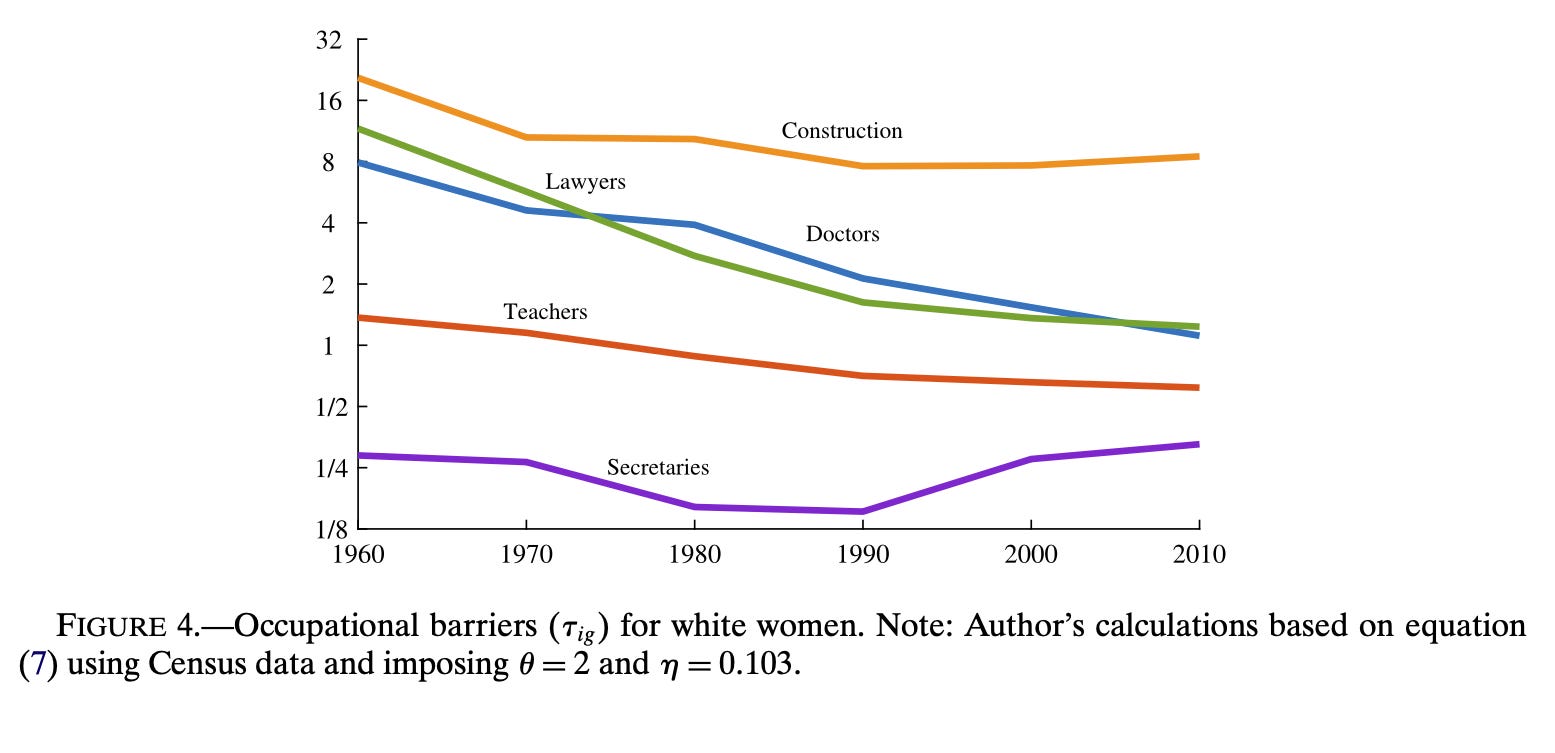
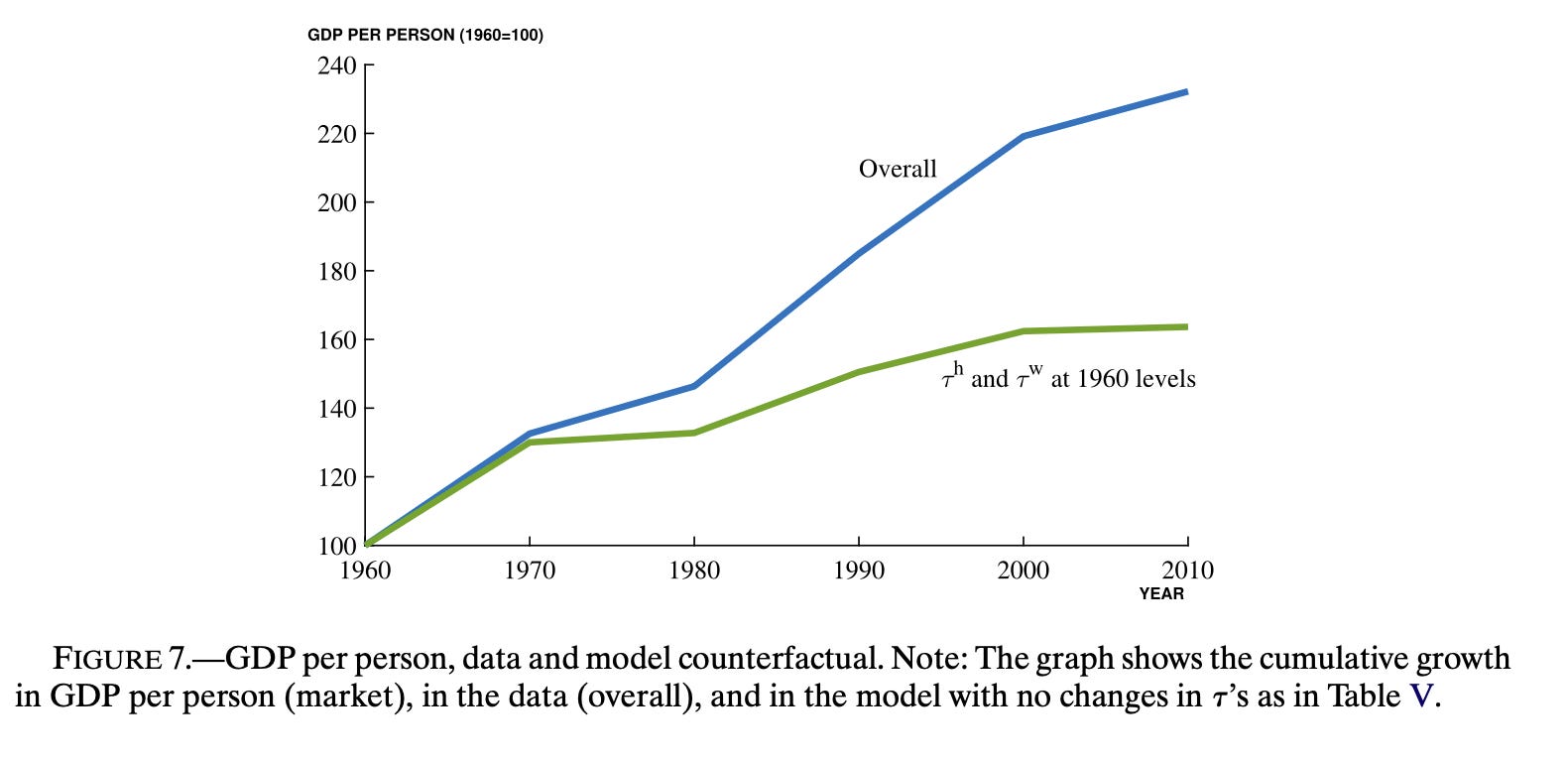
More broadly, HHJK find that large barrier reductions were concentrated in high-skill occupations, and in robustness checks they say much of the gain comes from women moving into lawyers, doctors, scientists, professors, and managers. These overlap closely with the institutions Andrews worries about. HHJK do not measure “deliberation” or “truth-seeking” directly. But they do show that as barriers in these professions fell and participation broadened, the resulting reallocation was associated with higher aggregate market output, not lower.
Over the last half-century, the opening of high-skill professions to women did not erode institutional performance. It was associated with roughly a third of the growth in U.S. market GDP per person.
A different diagnosis
This does not prove that every institution improves with every increase in female participation. It frames the burden of proof. A thesis that treats rising female participation as inherently corrosive has to argue that the performance gains from tighter “masculine” norms exceed the output lost to misallocation. Andrews does not state that trade-off in those terms. Her essay is not a growth accounting note. It is a diagnosis of institutional dysfunction, with gender composition as the upstream driver.
The WWII stress test pushes us toward a different diagnosis. The allocation evidence points the same way. When institutions fail, start with incentives, constraint management, and selection. Do not assume the gender mix is the primitive variable.
The modern institutional failures Andrews points to are real. Conflict avoidance, bureaucratic risk-aversion, the disappearance of frank internal debate – these are genuine problems worth diagnosing. But the diagnosis that follows from the WWII case, and from the long-run evidence on talent allocation, is not “too many women.” It is “misaligned incentives and blurred objectives.”
That is a more tractable problem. It is also, I think, the right one.
¹ In economic models, the variable being explained is usually written on the left-hand side of an equation, while the factors believed to determine it appear on the right-hand side.
Re reducing barriers: see Susan E. Riley, "Caring for Rosie's Children: Federal Child Care Policies in the World War II Era https://www.journals.uchicago.edu/doi/10.2307/3235099
Riley quotes Congressman Rolla McMillen (R-IL), speaking in May 1945 (after VE Day):
"I am afraid, Mr. Chairman, with this great grant allocated to child care, instead of discouraging it, it will encourage these women to remain in these plants, knowing that their children will be looked after. The policy should be, it seems to me, that they should be discouraged and driven, if necessary, back to their homes, where they belong, to look after these children."
WW2 is a poor example to use for a number of reasons. One of the key ones is that most women were line workers and had minimal impact on how the firm was run. The issue Helen Andrews raises is when women are in positions of power and in critical departments like HR where they can change the norms of behavior.