


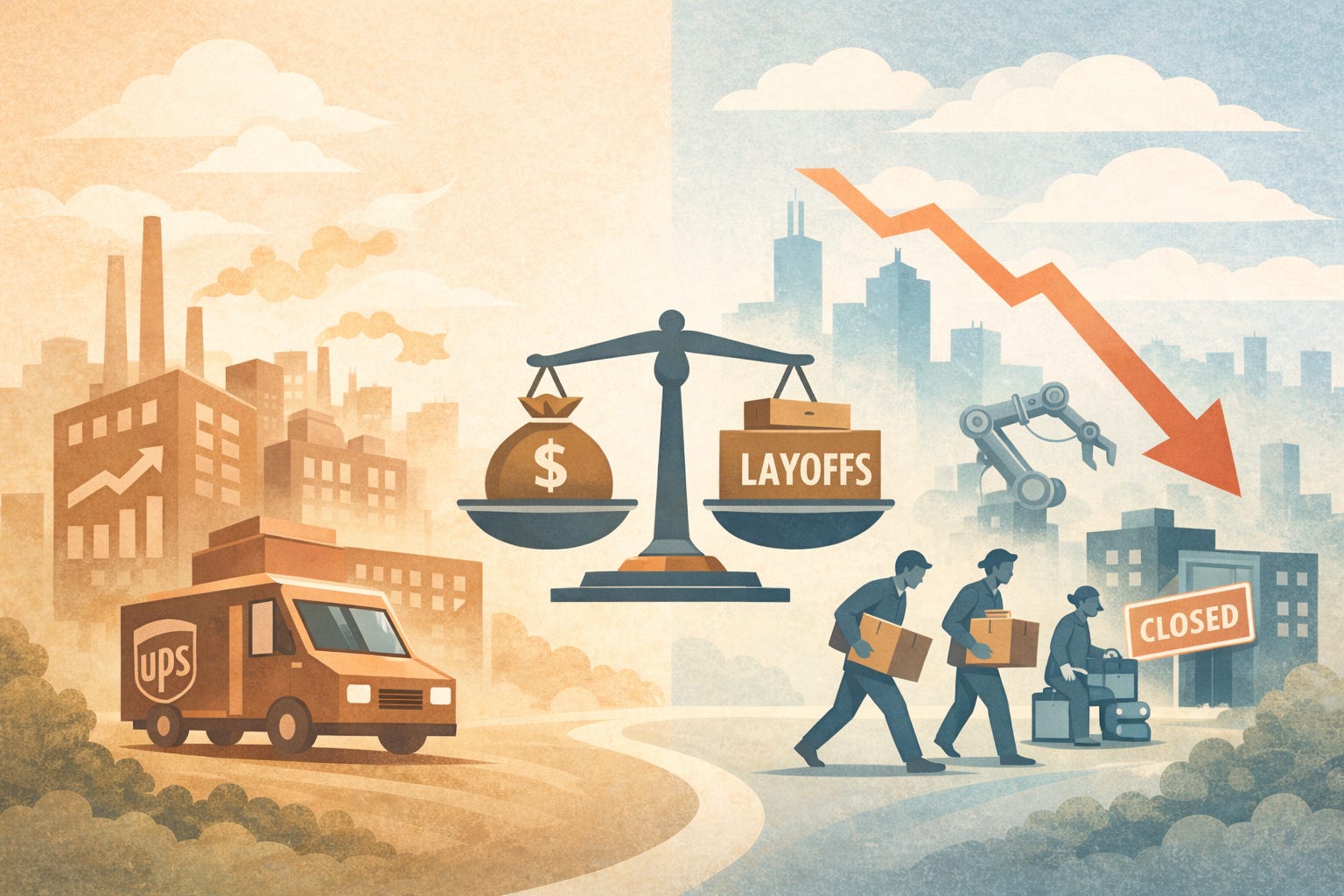
In 2023, the contract between UPS and the International Brotherhood of Teamsters, one of the world’s largest private sector unions, was widely described as historic. The agreement delivered large pay increases, expanded benefits, and introduced new work rules governing how labor is scheduled, deployed, and compensated. It was heralded as a turning point for workers in the shipping and logistics sector. For many observers, it appeared to demonstrate that aggressive bargaining could reverse years of stagnant wages and restore labor’s leverage.
Two years later, UPS is in the midst of a sweeping restructuring.
Since that contract, the company has eliminated 48,000 operational jobs, announced plans to cut another 30,000 positions, and closed or consolidated more than 100 facilities. Executives describe the effort as a necessary “right-sizing” of the business, driven by lower package volumes, higher operating costs, and a strategic shift away from less profitable delivery segments. As UPS’s chief financial officer has put it, “With less volume, we need fewer positions in order to support that volume.” At the same time, UPS is accelerating investments in automation and other capital-intensive operations, explicitly aiming to build a less labor-intensive delivery system.
It is true that the 2023 contract delivered meaningful gains. Many UPS workers now earn higher pay and enjoy improved benefits. But that is rarely the end of the story.
The question, then, is not whether the gains are real, but how the trade-offs unfold. Why do headline-grabbing contracts so often coincide with downsizing, automation, and job losses in sectors governed by exclusive, monopoly bargaining arrangements? When short-run wage gains are secured through monopoly bargaining power, where do the adjustments occur—and who ultimately bears the costs?
The evidence suggests that this pattern is not accidental, but a structural feature of monopoly bargaining. Our recent study (with Revana Sharfuddin), Do More Powerful Unions Generate Better Pro-Worker Outcomes?, helps explain why the sequence now unfolding at UPS is not an anomaly. Drawing on 147 studies, the paper shows how monopoly union power tends to shift costs into the future, where they often appear as reduced employment, lower investment, and faster automation—often to the detriment of workers over time. This suggests that improving long-run worker outcomes requires rethinking not worker voice itself, but the monopoly structure through which it is exercised.
Ultimately, this is not a story about unions versus employers, nor a judgment about intent or good faith. It is a story about institutional design and the incentives it creates. Specifically, it is about how systems of exclusive, monopoly representation shape bargaining behavior and firm responses in ways that can produce short-run gains for some workers while weakening long-run employment and opportunity for others.
What’s happening at UPS
According to UPS’s chief financial officer, Brian Dykes, the company is now in the most difficult phase of a large-scale restructuring. With lower package volumes, UPS is consolidating buildings, reducing hours, and eliminating positions. As Dykes explained, “When we started out with the labor contract, we knew that we were going to be investing in order to create a lower labor-intensive network.”
The numbers are stark. When the contract was ratified in 2023, UPS employed approximately 340,000 Teamsters-represented workers. Since then, the company has announced roughly 48,000 job cuts, with another 30,000 planned. UPS describes these reductions as roles concentrated in its logistics and delivery network, though it has not specified how many of those positions are covered by the Teamsters contract.
If the reductions were concentrated primarily among union-represented workers—and not offset by additions—the bargaining unit could theoretically be as low as roughly 290,000 today. There is currently no public confirmation that this is the case. Even so, if only a portion of the announced cuts affected Teamsters positions, the scale of workforce adjustment is substantial relative to the size of the 2023 bargaining unit.
At the same time that UPS appears to be shrinking parts of its workforce, it is also investing in automation and other capital-intensive operations.
From an economic perspective, this adjustment is unsurprising. The 2023 agreement significantly increased labor costs and altered work rules, while even the threat of a strike disrupted business activity. Firms respond to sustained cost increases and lost volume in predictable ways.
Of course, there were real gains for workers who remain employed. But when the marginal cost of labor significantly rises without a corresponding increase in productivity, firms adjust—by reducing headcount, accelerating automation, or reshaping their business models.
Isolating a single causal factor behind job losses is always difficult. But several pieces of evidence suggest that the 2023 contract—and the strike threat surrounding it—likely contributed to UPS’s subsequent adjustments.
First, timing. At the peak of the summer 2023 negotiations, roughly 1.5 million packages per day were diverted from UPS amid strike concerns. By October, only about 600,000 had returned, and FedEx reported retaining approximately 400,000 daily shipments. Executives also attributed roughly $1 billion in lost revenue to the disruption.
Second, the composition of losses. UPS deliberately shed its largest customer, Amazon, cutting volumes by roughly 50 percent because those shipments were no longer sufficiently profitable under the new labor-cost structure. This was not a general market contraction; it was a strategic response to changed economics.
While macroeconomic headwinds affected all logistics firms, UPS lost volume faster and recovered more slowly than competitors facing similar conditions. Its post-contract cost structure changed the profitability of certain routes and customers in ways its competitors did not face.
The margins firms adjust on
A central lesson from labor economics is that firms rarely respond to higher labor costs by simply accepting lower profits indefinitely. Instead, they adjust along several margins:
Employment: reducing headcount, limiting new hires, or increasing attrition
Capital substitution: investing in automation and technology
Scale and scope: shrinking operations, closing facilities, or exiting lines of business
Location: shifting activity geographically
This is exactly what we observe at UPS. The company has shed less profitable business, closed facilities, reduced staffing, and accelerated automation.
A similar pattern appears in the historical record. Research on the decline of Rust Belt manufacturing from 1950 to 2000 finds that powerful unions and frequent labor conflict played a significant role in the region’s employment losses—more so than globalization in the early decades. Wage premiums persisted even as investment slowed and firms gradually shifted operations elsewhere. When labor costs significantly rise without corresponding productivity gains, firms adjust over time. The Rust Belt shows this dynamic unfolding over decades; UPS illustrates it in real time.
What 147 studies tell us
Our paper reviews 147 studies examining the relationship between union power, employment, investment, productivity, and firm performance across the U.S. and Europe. The results are strikingly consistent.
Unions operating under exclusive, monopoly representation tend to raise wages and benefits in the short run. But those gains are frequently accompanied by:
Slower employment growth
Lower investment and capital formation
Reduced profitability and productivity growth
A higher likelihood of downsizing, automation, or firm exit
In other words, monopoly bargaining power often shifts costs into the future, where they appear as fewer jobs, fewer opportunities for marginal workers, and greater exposure to technological substitution.
This raises a recurring question: whether union “victories” can sometimes be illusory—real gains today that obscure longer-run costs borne by workers tomorrow. The evidence suggests this trade-off is not incidental; it is a structural feature of monopoly bargaining.
Why monopoly representation matters
The issue is not union representation. Worker voice is essential. The issue is how representation is structured—and how concentrated bargaining leverage within a monopoly framework can shape long-run firm and employment outcomes.
Under U.S. labor law, a single union typically becomes the exclusive representative for all workers in a bargaining unit. Workers cannot choose alternative representation or negotiate individual arrangements outside the collective framework, as most non-union workers do. Once certified, the union faces limited competitive pressure.
This monopoly structure shapes incentives in important ways:
Bargaining emphasizes immediate compensation over employment margins
The costs of aggressive bargaining are often delayed and concentrated in future employment adjustments
Marginal workers—new entrants, part-timers, and lower-seniority employees—are the first to lose
The UPS case illustrates this clearly. When the 2023 contract was ratified, the Teamsters represented roughly 340,000 UPS workers. While the company has not disclosed how many of the announced job cuts affected union-represented roles, if a substantial share were concentrated in the bargaining unit—and not offset by new hiring—the number could be closer to 290,000 today.
A pro-worker path forward
The evidence points to a more constructive alternative. In labor markets where worker representation is competitive or pluralistic, outcomes tend to be more balanced—with less extreme swings between wage gains and employment contraction. Workers retain voice and bargaining power, while firms maintain flexibility to invest and grow.
Some European systems separate worker voice from wage bargaining, allowing multiple forms of representation within firms. These systems reduce winner-take-all dynamics and better align compensation with productivity and long-run firm performance.
Competition disciplines behavior—for firms and for worker representatives alike.
If policymakers want to improve long-run worker outcomes, the focus should shift from strengthening monopoly bargaining power to expanding worker choice and representation options.
One reform could do this directly: allow employees who opt out of union membership to negotiate directly with their employers, while union members remain covered by collective agreements. Workers who opt out would also opt out of union representation—eliminating free-rider concerns and forced monopoly representation. This resolves a long-standing tension in labor policy by eliminating both forced representation and free-rider concerns.
Another reform would be to apply antitrust principles more consistently in labor markets. Simple rule changes—such as limiting excessive union market share or clarifying that a single union should not represent multiple firms whose merger would violate antitrust law—would help prevent the entrenchment of labor monopolies while preserving worker voice.
Such reforms would strengthen worker voice by making representation more responsive, more accountable, and more compatible with both wage growth and employment stability.
UPS is the symptom
UPS is not an outlier. It is a case study in how monopoly bargaining can generate short-run wins that give way to long-run adjustment costs. The layoffs, automation, and restructuring now underway are not a repudiation of workers’ worth. They are the predictable response to institutional incentives.
If we want labor markets that deliver both higher pay and durable jobs, we need to rethink how worker representation is structured.
Public sector unions are problem for tax payers.