


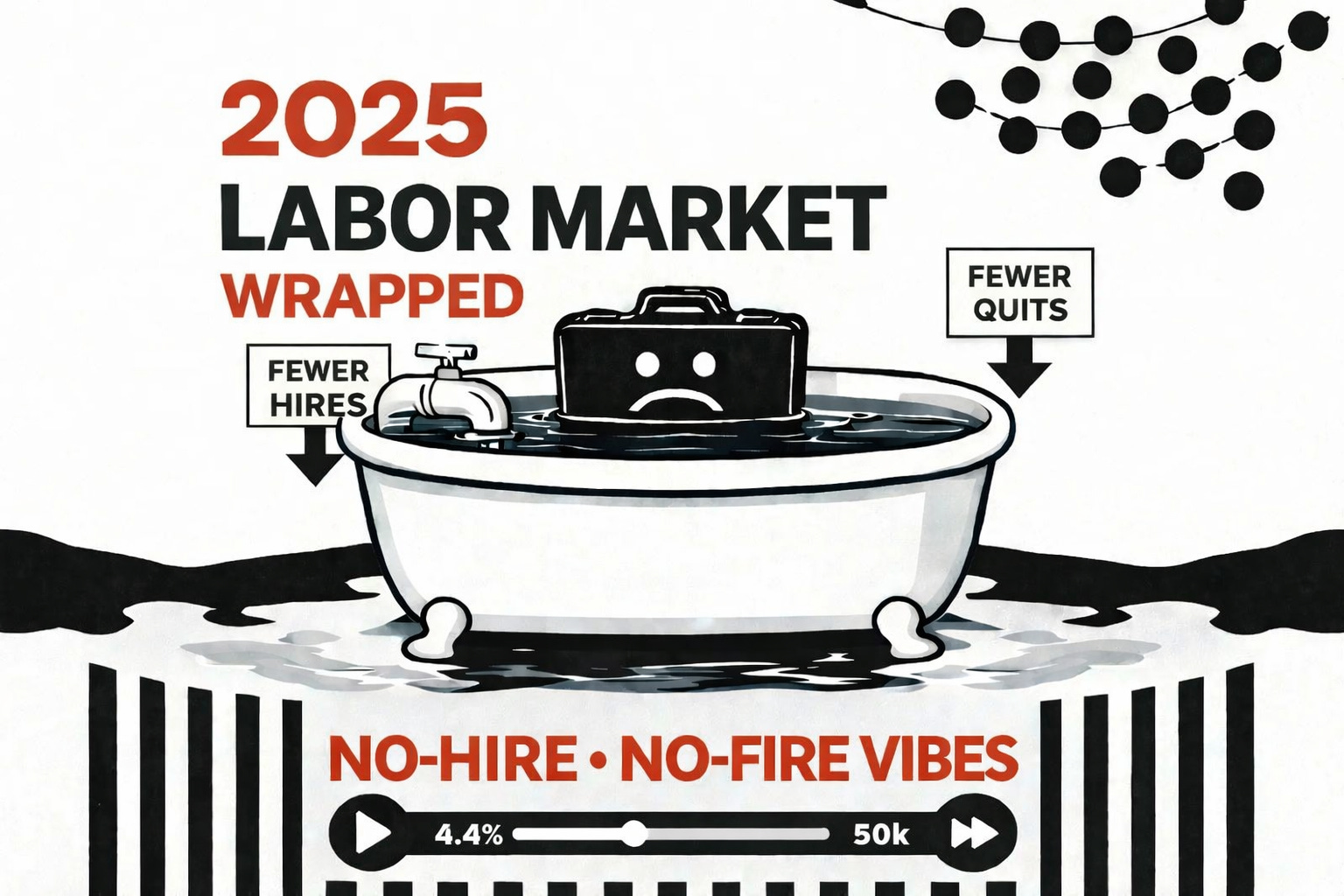
If you talk to job seekers right now, a common complaint is: “It’s not that everyone is getting laid off—it’s that nothing is moving.” Hiring feels slow. Offers feel scarcer. And yet we don’t see the classic recession headline: mass layoffs, unemployment spiking, separations exploding.
It only looks like a contradiction at first glance. It is, in fact, a coherent labor‑market regime—one that labor economists often describe as low churn (few hires, few quits, few layoffs) and that, in steady‑state terms, can look “stable” in the aggregate while becoming less opportunity‑rich underneath.
From mid‑2025 into early fall, the headline data increasingly fit this story: unemployment drifted up, but the engine of job loss did not shift into high gear; instead, much of the softness showed up as subdued hiring and slower reallocation—a labor market that looks close to a steady‑state, low‑churn equilibrium.
The key idea I want readers to take away is simple:
A labor market can cool mainly by becoming less “opportunity‑driven” (fewer hires, fewer quits, fewer openings) rather than more “separation‑driven” (more layoffs). That kind of cooling can raise unemployment gradually—without producing the layoff wave that defines a recession.
I start with the intuition and then provide a disciplined read of the late-2025 data.
Steady state in labor economics: the “stocks vs flows” way to think.
Most headlines fixate on stocks: the unemployment rate, the number employed, the payroll level. Labor economists care at least as much about flows: How many people are losing jobs (separations, especially layoffs)? How many people are finding jobs (hires/job‑finding)? How many people are moving voluntarily (quits)?
A good mental model is a bathtub:
The water level is the unemployment rate (a stock).
The faucet is inflows into unemployment (separations).
The drain is outflows from unemployment (job‑finding).
In a steady state, the bathtub level is roughly constant because the faucet and drain balance.
A one‑line “sidebar equation” (intuition, not derivation)
A standard steady‑state approximation is:
u ≈ s / (s + f)
Where:
u is the unemployment rate
s is the separation (job‑loss) rate into unemployment
f is the job‑finding rate out of unemployment
Read it like this: unemployment is high when separations are high or job‑finding is low.
So here is the crucial point for late‑2025:
You do not need a surge in layoffs (s) to see unemployment drift up. If hiring slows and job‑finding probability falls (f declines), unemployment can rise gradually even with stable separations.
That’s the “no‑hire, no‑fire” logic in steady‑state form.
(Technical footnote: the model object f is an unemployed‑to‑employed transition hazard. The JOLTS hires rate is not the same object, but it is an empirically useful indicator of how “opportunity‑rich” the market is.)
What a Hiring Freeze Looks Like in 5 Charts
A brief housekeeping note: the 2025 federal government shutdown caused a brief CPS disruption, concentrated in one or two months. I’ll focus on multi‑month trends and cross‑check CPS (unemployment, participation, EPOP) against JOLTS (openings, hires, layoffs). The signal in late‑2025 is a market cooling via slower hiring and weaker churn, not a surge in layoffs.
1) Hiring is trending down, while layoffs remain low
This is the cleanest “low‑churn” picture. Over 2022–2025, the hires rate drifts down while layoffs/discharges remain low and relatively stable. The market is cooling primarily on the job‑creation / match‑creation margin, not the job‑destruction margin.
2) Job openings have normalized from extraordinary highs
Openings soared in 2021–2022 post pandemic, then moved down markedly. By 2024–2025 they look more like a market that is no longer overheated—but also not collapsing. That matters because openings are the labor‑demand side of the matching story: fewer openings generally means fewer opportunities.
3) Unemployment drifted up, not spiked
Unemployment rises gradually across 2023–2025 rather than jumping the way it typically does when layoffs surge. That pattern is consistent with a fall in job‑finding, not a sudden wave of job destruction.
4) Participation is not doing the explanatory heavy lifting
Participation is relatively stable in this window (with modest month‑to‑month movement). That makes it harder to explain the unemployment drift as “just” labor force entry. In a steady‑state lens, that pushes you back toward the idea that job‑finding is getting harder at the margin.
5) The Employment‑Population Ratio signals a hiring freeze
The employment-population ratio (EPOP) is the share of the population that’s working. It’s a simple way to see whether employment is still expanding relative to population. The figure above shows a clear post-COVID arc: a sharp collapse in 2020, a strong rebuild through 2022, and then a long plateau around ~60. The key late-2025 signal is the final leg: EPOP drifts down through 2024–2025, indicating that employment growth has slowed relative to population.
Put that next to unemployment inching up and you get a coherent read. This looks like a hiring-freeze phase—slower job creation and fewer new matches—rather than a labor market breaking via mass layoffs.
Why low hiring and low firing can coexist
From a search‑and‑matching perspective (Mortensen‑Pissarides), the labor market is a market for new matches as much as a market for existing jobs. Job creation and job destruction are endogenous and can respond differently to shocks.
Firm‑side caution: fewer postings, slower backfilling
When firms are uncertain about demand, costs, financing conditions, or policy, a common response is not to lay people off immediately. It’s to: post fewer vacancies, take longer to fill them, not backfill departures quickly, reallocate internally rather than expand headcount. That reduces hires without requiring a spike in layoffs.
Worker‑side caution: fewer quits, fewer job‑ladder moves
A big part of churn is voluntary. When quits fall, job ladders slow down: fewer voluntary exits means fewer openings created by churn, which means fewer hires.
Matching and reallocation: low churn can mean less dynamism
Low churn isn’t automatically good. It can mean fewer mismatches get resolved, fewer productivity‑improving reallocations occur, and outside options weaken—pressuring wage growth and mobility.
Why this isn’t a classic recession pattern—yet
The canonical recession labor market is separation‑driven: layoffs rise, job losses broaden, unemployment rises quickly.
What your JOLTS figure shows is closer to a hiring slowdown than a layoff shock: layoffs/discharges remain low by recent historical standards, while the hires rate has been drifting down.
That’s why the honest read is: softening, not breaking.
But “not a recession” is not the same as “healthy.” And that’s where composition and opportunity matter.
Relative to 2015–2019, the Beveridge curve shifted outward after 2020—openings were unusually high even at low unemployment—consistent with elevated matching frictions. Since 2022, the market has moved down/right as hiring cooled, and the curve appears to be edging inward, though it still looks more vacancy-heavy than the 2015–2019 baseline.
The Beveridge Curve says this is a hiring slowdown more than a firing shock)
One of the cleanest ways to see whether a labor market is cooling through fewer new matches (vacancies/hiring) versus more job destruction (layoffs/unemployment) is the Beveridge curve—a scatter/line plot of the job openings rate (vertical axis) against the unemployment rate (horizontal axis).
It’s usually downward-sloping: when the economy is hot, openings are high and unemployment is low (upper-left). When the economy cools, openings fall and unemployment rises (down-and-right). The key is how you move.
The Beveridge curve makes the shift easy to see. For example in March 2022, openings were 7.4% with unemployment at 3.7%—a market defined by abundant opportunities and fast churn. By November 2022, openings had already cooled to 6.4% even though unemployment was still 3.6%. Fast‑forward to November 2025: openings are down to 4.3% while unemployment is 4.6%. The headline change isn’t a sudden unemployment spike—it’s the steady drop in openings. A market that feels stuck even without mass layoffs.
That pattern is exactly what you’d expect from firm-side caution under uncertainty. Instead of immediately shedding workers, firms often: post fewer vacancies, slow down hiring, take longer to fill roles, and don’t backfill departures quickly.
In Beveridge-curve terms, that shows up first as a drop in vacancies—often before you see a dramatic jump in unemployment.
A second takeaway is about tightness: a rough proxy is vacancies per unemployed (V/U). For example, in March 2022, the chart implies roughly 2 openings per unemployed worker (7.4/3.7 ≈ 2.0). By September 2025, it’s closer to one-for-one (4.6/4.4 ≈ 1.05). That’s a big shift in bargaining power and outside options consistent with slower job-ladder moves, fewer quits, and softer wage pressure even without a layoff wave.
Finally, the post-2020 path in the figure sits above earlier “normal” decades at comparable unemployment rates. That’s often read as some combination of lingering mismatch/frictions and lower matching efficiency—another way of saying: even when there are openings, the market isn’t translating them into hires as smoothly as in the past. A low-churn environment can do that.
The elephant in the room: tariffs and a labor market stuck in wait-and-see mode
In a textbook cyclical downturn, the labor market usually “breaks” first on the match-destruction margin—layoffs and separations surge as firms unwind existing matches—so the fact that layoffs remain anchored is strong evidence that late‑2025 is not primarily a broad demand-driven recession shock.
Instead, the pattern fits an external cost/uncertainty regime that raises the option value of waiting, and the elephant in the room is tariffs: economists are overwhelmingly agreed that tariffs are borne largely at home through higher prices/costs (not “paid by foreigners”), as reflected in near‑unanimous expert-panel responses.
The most rigorous recent macro evidence for the U.S. finds that tariff shocks depress trade, investment, and output persistently—and reduce employment—while trade-policy uncertainty is contractionary as well. Consistent with your “no‑hire, no‑fire” mechanism, state‑level evidence shows that greater exposure to trade policy uncertainty reduces hours and employment mainly via the extensive margin, because firms postpone hiring.
And the last trade war’s micro evidence lines up: import protection did not deliver local job gains in newly protected sectors, while retaliatory tariffs produced clear employment losses—exactly the kind of environment that freezes vacancies and mobility without requiring a layoff wave.
What about AI?
I would be cautious about making “AI job destruction” the leading explanation for late‑2025 labor‑market softness. The empirical literature on generative AI so far reads more like within‑job task change and productivity effects than economy‑wide displacement.
More importantly for interpretation, if AI were already “stealing jobs” at scale, it should be visible in the labor market’s most basic destruction margin: layoffs. That’s where true displacement shows up first. The JOLTS data simply don’t show a large, broad-based rise in layoffs or discharges—suggesting that whatever AI is doing right now, it is not manifesting as an economy-wide wave of job destruction.
That doesn’t mean AI won’t matter. It means the most defensible claim from the 2025 flow data is: the labor market is slowing through hiring and reallocation, not through mass separations.
Bottom line: steady ≠ healthy
The labor market in late‑2025 looks increasingly consistent with a steady‑state, low‑churn regime: hiring is subdued, and firing is still low. That combination can keep unemployment from exploding—even as it drifts up—because the economy is adjusting through reduced flows rather than a surge in separations.
But a freeze is the opposite of dynamism.
A labor market can look calm because it’s moving slowly—like a river that isn’t turbulent because it isn’t flowing much at all. In that world, the key margin isn’t whether layoffs spike tomorrow; it’s whether the market keeps creating new matches, new opportunities, and upward moves.
The risk isn’t only recession. The risk is quiet stagnation: fewer ladders, weaker bargaining power, and a labor market that stays “steady” by offering less.